Showing posts with label writers are weird. Show all posts

Wednesday, 19 August 2015

Of Books & Blogs (or how to get over a bad writing day)

typewriter
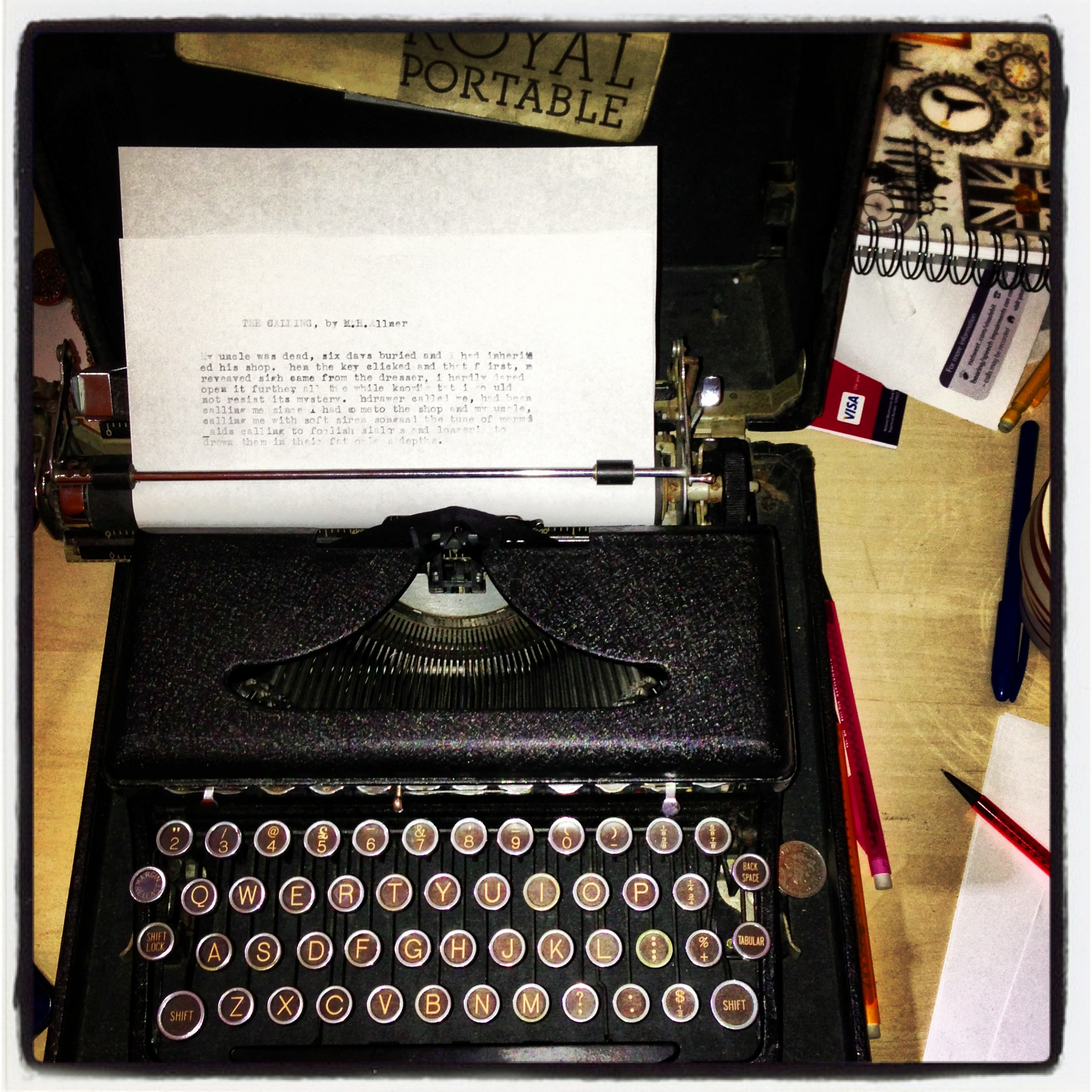
Spending the weekend out of London to look after the family dog, my plan was also to spend some quality time writing. I figured I’d get out my typewriter - there’s no where really to keep it in my flat (and the walls are definitely too thin) meaning it currently lives at my parents – so I lug it downstairs and set it up in the kitchen.
I make a coffee. I stack my notes up next to me. I turn on my dad’s epic sound system prepped to blast the soundtrack I’ve put together. Then sitting with a happy dog at my feet, I ready the page, my hands hovering over the keys. And I can feel them: the words at the corners of my mind, so close I can smell the ink… my fingers twitch...
And nothing happens.
Like having that ‘tip of the tongue’ feeling, the words buzzed, blurred and faded before they could become sentiment or sentence.
I tried. I probably wrote two or three pages of first paragraphs and outlines, odd bits of dialogue and random incomplete phrases. But nothing concrete found its way onto the page.
typewriter

How people write has always fascinated me.

Gore Vidal established the now inevitable coffee/writer relationship, swearing by a ritual of ‘First a coffee, then a bowel movement and then the muse joins me;’ whereas Balzac scribbled furiously for fifteen hours every day (he did succeed in writing hundreds of novels) and fetishised every sentence in editorial. So when it comes to the living, sometimes I desperately wonder: Where do your ideas come from, Mr Gaiman? How did you find the link between birds and brains Mr Powers? What made you want to write, Ms Atwood? And for that matter: what keeps you going?
What keeps them going, what their ‘fix’ is, what’s really going on behind the invisible wall of the page – it’s intriguing as much as it is, perhaps, a little voyeuristic (would you really want to share your bestworst habits with curious minds?).
There’s a book I received, I’d like to say for a birthday, about exactly this ‘Secret Life of Authors.’ Illuming the trinkets and rituals that inspire some of today’s writers, it will one day make excellent toilet reading with each insight coming in page long snippets. Will Self, Ian Rankin, A.S Byatt, Jonathan Lethem, Nicole Krauss, Tash Aw – they all have ‘things’, ‘hobbyhorses’ that inspire or trigger that avalanche of thought.

When I was younger and writing was easier, I never understood why The Adults complained about bleeding into their writing.

Couldn’t they just exist there in the words? All I wanted to do was write: at break time, lunchtime, prep time, dinner time, after dinner, after lights out. I had some great teachers. My French teacher – who you can see giving a TedXTalk – was an Oxford man who used to let me write in his class because if I cared more about words then his lesson, then I should follow that passion. Another, now more commonly know as author Virginia McGregor, even started up a creative writing group in which half the time I’d sit doing my own thing because prompts have never triggered much for me. She allowed it, mostly.
Now, I can sort of see why people who want to write become bogged down. After all, there I was, ready to write, notes at hand, perfect music, perfect day, perfect, perfect, perfect. And nothing. Not an inkling. Not even a hint of an inkling. Stilted. Broken. Blank.
Perhaps I overdid it – there was such a sense of preparation about being on the farm, with the typewriter and the music and the old dog. It was like scheduling a romantic evening then realising it feels like a funeral with the dead flowers and candles and mannered conversation.
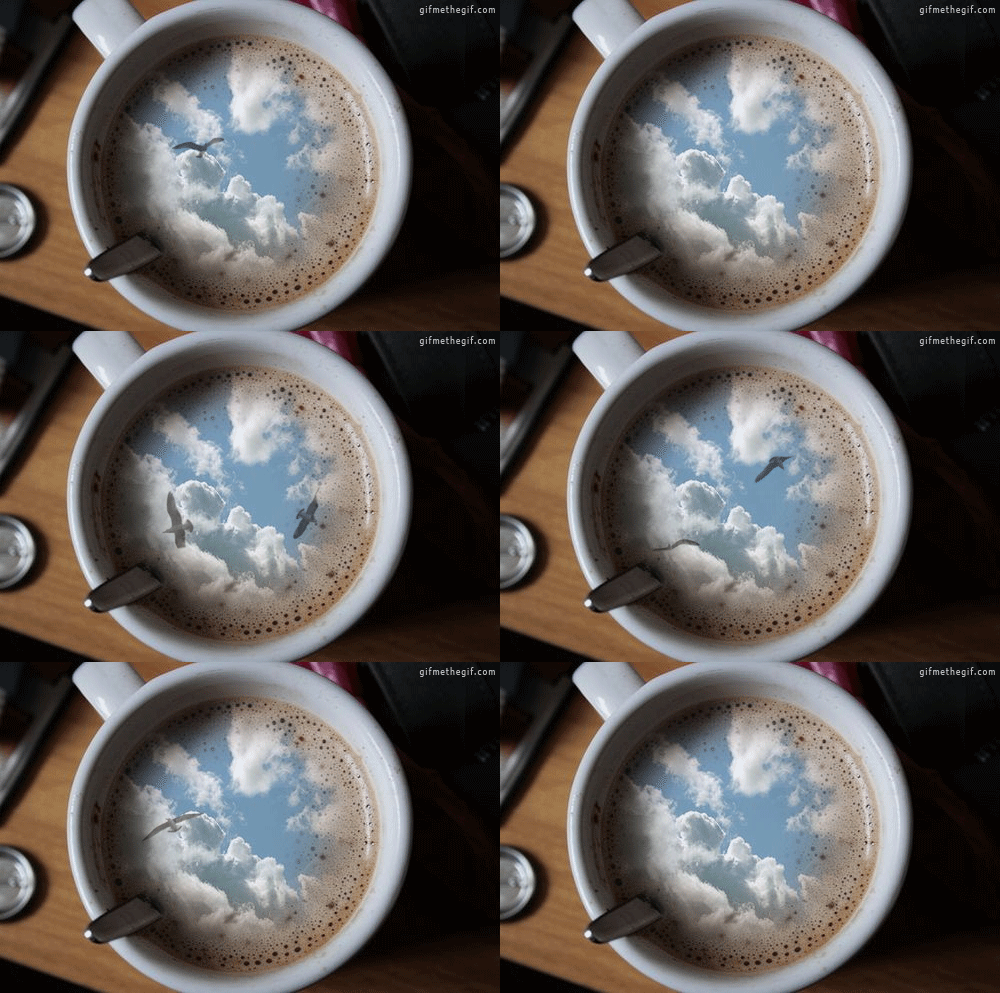
So I stopped writing. I turned off the music. I pulled the pages from the typewriter, stacked them on top of my notes (who knows, maybe a flake of genius is in there after all #hoarder). And I went outside with the dog to finish my third coffee.
coffee

Right now, I’m sure there’s a few readers shaking their heads.

What’s the first rule of aspiring novelists? Keep going - write – write anything – just bloody write.
But I hate that rule.
I don’t write because other people tell me to finish. I don’t write for the sake of writing. I write for the sake of me. Because when I don’t write it’s like when a hangry person hasn’t eaten.
Obviously, if you want to be a writer then time has to be spent writing. Because if only you’d stop talking about your novel and start writing your novel, because if only you made time for your novel instead of complaining about your work hours, because if only you’d just put one word in front of the other and finish what you’ve started then maybe – maybe – you’ll be en route to being an author.
But it shouldn’t mean sitting with half-formed things twisting beneath your fingers that aren’t ready. Forcing words out for the sake of it shouldn’t be the first titbit of advice to give to anyone writing their book.
Sometimes, that approach can be more damaging than helpful. It can make you resent the work, want to neglect the idea.
Personally, the feeling of Presque Vu is usually because I’m worn through and I need to do something else. It’s not writer’s block (where the blank page is winning so hard it hurts and it really is a matter of writing anything to defeat it), this is the feeling of otherness that comes from too many expectations and pressure. When my head is in it but the rest is pure automaton.

So here’s what I do if writing feels like falsehood.

  1. Write something else. Blogs are good for this and they often relieve some of that pressure.
  2. Make notes. Draw plans. Draw characters. Draw a tree or a map. Whatever, do something with your hands.
  3. Read. Books are good for the soul, make you more intelligent, stave off dementia, and are the blood of good writing. Just ask Hemingway.
  4. Watch a film – I’m not talking a Netflix binge. Watching something challenging or a documentary that ties into your book can help.
  5. Drink - coffee, tea, whiskey, Hangman's Blood, pick your poison and have a cup of your favourite brew if you think it'll put you in the zone.
  6. Talk to yourself. Struggling with dialogue? Act it out. You might look like a lunatic but ask Nerd Cactus and you’ll find at least one of them finds this central to her creative output.
  7. Talk to someone else – not about writing. Leave the book alone.
  8. Go for a walk. Go enjoy the outdoors. Get on a bus and go somewhere. Sometimes we spend so much time inside four walls, it’s just not healthful. Visit life.
  9. Do something you enjoy – whether that’s singing like no one can hear you, dancing around in your underwear, or throwing fruit off a rooftop – go find your happy place.
  10. Don't beat yourself up over it. If you're writing regularly and not just talking about writing regularly, these days will happen. It's a bad writing day. They're there to make the good ones even better.

Je serai poète et toi poésie,
SCRIBBLER

Sunday, 16 August 2015

Of Astronauts & Authors (or why writers dream big)

Recently, I’ve read a lot about the role of the online world in the lives of writers. At the Writer’s Digest Annual Forum 2015, FutureBook were there on stage talking about writing and the community, assessing the impact community has had upon the way we write and the way we publish literature.
“Once,” they commented, “writing was the most solitary of professions; now it’s the most social.” 
And that made me think. Who would I be today if not for the initial spark of encouragement to write? Who would I be without my community, my writing buddies like Nerd Cactus, or more recently my boxing partner who spars with ideas as much as her fists?
map-of-online-communities


Until I was about eight, I wanted to be an astronaut.

I was born the year the walls came down and the webs went up. It was the last year of the Cold War. The first year of the Internet Age.
My dad had a mobile phone that looked like a defibrillator and our little family of three lived in a many-storied townhouse in Wandsworth. It was at least a decade before it became fashionable to live there. At one end of our road was a school for badly behaved boys and at the other an ageing hooker worked the corner, flashing sagging lingerie and raw gums to anyone who stared.
A few years later and the family had grown – the twins had arrived and the dog was given away. My brother and I pushed my sister down some stairs (I don’t think it was deliberate). We moved out of London to an old farm with far fewer staircases. Out there, in the countryside, you could see stars. I don’t think I’d ever seen them properly, living in the city, and I remember spending hours with my dad staring upwards with him pointing out Ursa Major, Ursa Minor, Orion’s Belt and Sword, Cassiopeia, Gemini, Draco.
At the time, no one realised how crap I was going to be at maths and physics – or that I’d turn out to be terrified of flying – but there it was: whilst everyone else wanted to look after fluffy animals or was fussing over their Barbie’s latest car, I was organising Beanie Babies into rocket ships and sending them off to Mercury. I’d imagine them running around trying to find the cold side of the planet the same way you chase the cold side of a pillow.
Even as pre-teens we knew the basics of computers – how to cut, paste, copy, undo, and how to take part in online games. The sound of dial-up modem added a beep-beep-boop-whirligig tone to our childhood.
Then I had The Teacher. A title that here refers to one of those fizzbubbling educators that make you enquire within about everything. She set an assignment: use alliteration, similes and metaphors in a one-page ‘fill in the blanks’ exercise. Me being the precocious and loquacious brat that I still am, handed back a three page story ‘TBC’.

She replied with a bumblebee sticker and offhand reassurance: you should write a book.

So I did.
I started straight away. Finished it when I was thirteen. It was god-awful. Every chapter introduced a new character or someone got kidnaped. I invented mythical beasts called Raziguls that looked like a kraken drawn by a clay-brained, knotty-pated fool (aged 13 I liked to think I was good at art but I have about as much talent for it as Katie Hopkins does tact).
My parents were kind. They were nice about my new hobby. They indulged me as I turned up the volume on Dark Side of the Moon and spent hours scribbling.
They also let me use the Internet. From 6pm onwards, when dial-up was cheaper, I was allowed to go online and browse. I quickly became part of my first online writing community: Stories.com (now Writing.com).
Writing was like the lights turning on. I started typing tales with other people, posting and sharing my work, giving and receiving feedback.
Dreams of going to the moon simmered away as I realised, with words, I could go to any planet I wanted and take other people with me. And all those constellation, they had stories to tell. Writing became essential. To feel the body electric.
Stories are the first and most primal virtual reality. They are inherently social - blurring and blending the boundaries of self and other. We might construct them as individuals but they are shared spaces, interactive spaces between reader, author and text.
Think of it this way: through fiction, life becomes like a house riddled with a thousand secret passageways to other houses, other dreamscapes and landscapes and worlds. Through the Internet, those metaphorical spaces become even more extensive and multi-dimensional. They invite you not just to walk through other people’s houses but to help build them.
Moreover, as the Internet has grown, as computerized, multilinked writings that are as integrated as any social network have extended, the nature of the literary has only expanded to become more inclusive, more allusive, more virtual. And this, from where I’m typing, is closer to the social mind than ever.

Flash forward a few years.

It was around university when I started to become disillusioned with larger communities online. There was so much pressure to be involved with everyone else that I'd forgotten about my own work and ideas. And whilst I appreciated the odd pats on the back from strangers, I relished the feedback that was brutal, honest, insightful. I hated the platitudes people offered: ‘Buddy, I’m so sorry your story got rejected – I’d give it 1000% out of ten, ignore the haters.’ There was so much of the Simply Positive attitude when what I needed was someone who’d help me kill my darlings. Even if they just whispered over my shoulder whilst I pulled the trigger.
From where I was sitting, editing had fallen into a rut. Editors are supposed to edit: well, of course. What else should they do? But the turning wheel of the publishing industry made it seem that publishers no longer read like writers. They read like accountants. Where were the Claire Walshes or the James Woods or the Gertrude Steins? Where were the editors – not the publishers – who’d tear a book a part and then give the writer a needle, thread and an outline by which to stitch it back together again?
claire walsh
So I took a step back. Not a big one, but enough that I was able to focus more on my own writing and on offering to others the kind of feedback I thought was valuable. I started reading like a writer. Editing. It was 2011. Jonathan Franzen had just had some trouble with his book, Freedom, which to his utter dismay was launched in bookshops riddled with errors he’d thought edited out weeks previously.
Today’s social landscape is shaped by the pervasive influence of digital technology. It’s created a paradigm shift in the way that we live, interact, think of others and ourselves. It’s transformed writing and publishing. It has the potential to do great things for literature. And is doing them, in some places.
The digital has not destroyed writing, or relegated editing to the cemetery of forgotten talents. It’s just taken a little while for the literary business to balance out again with literary art. Dig below the surface, innovators exist. Dig deeper, communities can be helpful (see Writer Unboxed), provide support and genuine feedback.

I’ll never regret being part of online culture or writing circles.

Writing is solitary. To have a group that understands your problems and will have those peculiar conversations about writing can be stimulating and may even help when it comes to marketing and selling your work. Through it I’ve met people I admire, people I adore, people I'd play my part for if it'll help them succeed. They're adventurers too. And I suspect a fair few of them wanted to be astronauts back in the day.
So whilst I resent Team Follow Back, I also respect it. And whilst I roll my eyes at automated content, I understand why there’s a need. And whilst I’d rather be on the periphery of a writing community, I will always make the effort to take part.
Fact is, I’m an inevitable creation of the Internet. A digital native. Comfortable online and offline. Aware that IRL is as imaginary as Hogwarts.
And if you’re reading this, most likely, so are you.


Je serai poète et toi poésie,
SCRIBBLER

Monday, 27 July 2015

19 Conversations Writers Can Only Have with Other Writers


From Edgar Allen Poe to Stephen King, Honore De Balzac to Enid Blyton, the introverted Brontes to the quixotic personalities of JK Rowling, Ian Rankin or Neil Gaiman… writers are a weird bunch. It’s something of a trend in amongst the big names and the small names, the full-fledged authors and the still-trying scribblers.
Writers are quite candid about weirdness. Call it egoism (most people do) but we’re happy to acknowledge the quirks that make us quirky. Especially when we’re surrounded by other oddballs who understand a little of what we’re talking about. 

1. When we're with other writers, we know they get us

breakfast club

2. They understand the writing process. 

"Oh my god, I had the best writing day today. Everything I wrote was just so effortless. Like magic. There was a blank page and then there was thirteen written pages. Nothing else matters. Today was amazing."
200

3. Also: the right way to commiserate.

"Everything I wrote yesterday is complete horse dung - like seriously, I reread it all today and there's nothing salvable. I can't even explain. It's like having a screaming baby attached to your head whilst you paraglide towards a cliff when you realise your parachute is broken." "I'll bring the gin."
gin

4. Talking about writing instead of writing is nerdtastic.

"If his mother comes from a line of more general magic users, there's no reason he wouldn't be able to work with it. He wouldn't have the same facility with it as a human, but he can do it. It would definitely explain his difficulty in grasping the spell and making it work. And Hermes is known for being clever, so that helps, too. So long as his ability to access that magic isn't a go-to..."

5. Even when we're talking about not-writing instead of writing.

"I spent four hours yesterday writing one sentence. One sentence. And then I deleted it because it didn't even make sense so really I spent four hours writing nothing." "Know how you feel. I'm sitting here with my laptop and those cold unfeeling keys are glowering up at me, mocking me with their pitiless QWERTY know-it-all-ness, telling me I'm never going to write another word again."
writers block

6. Plus other writers understand our oddities

"Do you think it's creepy that I spent all day listening in on other people's conversations in Starbucks?" "Nah, I stalked a guy through the tube last week because I wanted to figure out how hard it would be to follow someone home."
creepy

7. And that the voices in our head can be really annoying…

“Urgh I’m so tired today, I was awake all night long. I had this ridiculous argument with Laras [insert other fictional character name here] about whether or not he’d kill his father with a gun just to spite him or whether they have an epic showdown on the top of a space hanger. He just wouldn’t let me go to sleep.”
voices in your head

8. Ideas can be equally unhelpful with their timing.

“So frustrating, I have an entire chapter plotted out for this week, but I’ve got this new character in my head and I really want to write down her story now before I forget it.”
unhelpful

9. Other writers get that even literary research can be killer.

“Do you think you could come over next week? I’m thinking my villain kidnaps this girl and I can’t decide whether he uses chloroform or Rohypnol, so I think it’s best if I try them both to figure out which symptoms last longest and stuff. Can you help?”
taylor swift

10. That some can really put you off your food...

“I want to figure out what a decaying body would smell like and I heard sausages left for a couple of days outside can give you a good idea… what do you think would be more authentic: sage and apple, or Cumberland leek?”
sausages body

11. Which explains why we're all paranoid about Google research…

“I’m really nervous about what people would say if they saw my search history...”
anigif_enhanced-8196-1437238266-3

12. Even for those of us writing non-fiction it can still get pretty weird…

“This was my editor today: hey can you sub the sanitary towel story? And what happened to that interview you did with the dominatrix last week? Do you want to run that online today or do you want to put it up with the article on the transsexual mother that’s really a father?”
stressed journalist

13. Who else can understand why rejection is so terrifying?

"What if they hate it? What if they hate me? What if no one will ever like my book and the paper it's printed on turns to dust and I've just wasted my life?"

14. Why negative reviews are so exquisitely painful...
"Do you even know what he said about my story? He said it was a nice idea. A Nice idea. Nice is what you call your neighbour's grandmother's Millionaire Shortbread. Nice is what you call a curry with no spices. Nice is sex with someone whose feelings you don't want to hurt but who you're never going to booty call again. Nice is people-pleasing and spineless and boring. Nice is the absolute worst."
54a78ad77197d_-_ugly_crying_21

15. Or why good reviews are the best thing in the bloody world?

"She called it brilliant! She loved my characters and thinks the narrative voice is super compelling! No, no let me read the review to you again... see this bit here."

16. The highs and lows of editing aren't strange to other writers.

Monday: "I love editing. It's so much fun! I forgot how much I love this story." Wednesday: "I hate editing. I'm killing my darlings. Killing. My. Darlings." Friday: "When will it end?!" Sunday: "Ah editing, thank you for letting me procrastinate from writing."

tumblr_mlv4orptYp1rhnk3wo1_50017. Neither is our caffeine addiction

"Tea. Coffee. I don't care. There's too much blood in my caffeine system right now for productivity and it must be rectified."
coffee

18. There's no judgement on our need for more books than we could ever finish

"I just loved the first book so much I bought everything ever written by the same writer..."

19.  In other words, it's nice to have a kindred spirit

"I know it's ridiculous but this sentence is just so gooooood... One day I'd like to write a phrase as perfect as this." "I know exactly what you mean. Ooo look at this one - imagine how satisfied Dickens must have been when he wrote that."
writers are psychos


Je serai poète et toi poésie,
SCRIBBLER