Showing posts with label social media. Show all posts

Sunday, 16 August 2015

Of Astronauts & Authors (or why writers dream big)

Recently, I’ve read a lot about the role of the online world in the lives of writers. At the Writer’s Digest Annual Forum 2015, FutureBook were there on stage talking about writing and the community, assessing the impact community has had upon the way we write and the way we publish literature.
“Once,” they commented, “writing was the most solitary of professions; now it’s the most social.” 
And that made me think. Who would I be today if not for the initial spark of encouragement to write? Who would I be without my community, my writing buddies like Nerd Cactus, or more recently my boxing partner who spars with ideas as much as her fists?
map-of-online-communities


Until I was about eight, I wanted to be an astronaut.

I was born the year the walls came down and the webs went up. It was the last year of the Cold War. The first year of the Internet Age.
My dad had a mobile phone that looked like a defibrillator and our little family of three lived in a many-storied townhouse in Wandsworth. It was at least a decade before it became fashionable to live there. At one end of our road was a school for badly behaved boys and at the other an ageing hooker worked the corner, flashing sagging lingerie and raw gums to anyone who stared.
A few years later and the family had grown – the twins had arrived and the dog was given away. My brother and I pushed my sister down some stairs (I don’t think it was deliberate). We moved out of London to an old farm with far fewer staircases. Out there, in the countryside, you could see stars. I don’t think I’d ever seen them properly, living in the city, and I remember spending hours with my dad staring upwards with him pointing out Ursa Major, Ursa Minor, Orion’s Belt and Sword, Cassiopeia, Gemini, Draco.
At the time, no one realised how crap I was going to be at maths and physics – or that I’d turn out to be terrified of flying – but there it was: whilst everyone else wanted to look after fluffy animals or was fussing over their Barbie’s latest car, I was organising Beanie Babies into rocket ships and sending them off to Mercury. I’d imagine them running around trying to find the cold side of the planet the same way you chase the cold side of a pillow.
Even as pre-teens we knew the basics of computers – how to cut, paste, copy, undo, and how to take part in online games. The sound of dial-up modem added a beep-beep-boop-whirligig tone to our childhood.
Then I had The Teacher. A title that here refers to one of those fizzbubbling educators that make you enquire within about everything. She set an assignment: use alliteration, similes and metaphors in a one-page ‘fill in the blanks’ exercise. Me being the precocious and loquacious brat that I still am, handed back a three page story ‘TBC’.

She replied with a bumblebee sticker and offhand reassurance: you should write a book.

So I did.
I started straight away. Finished it when I was thirteen. It was god-awful. Every chapter introduced a new character or someone got kidnaped. I invented mythical beasts called Raziguls that looked like a kraken drawn by a clay-brained, knotty-pated fool (aged 13 I liked to think I was good at art but I have about as much talent for it as Katie Hopkins does tact).
My parents were kind. They were nice about my new hobby. They indulged me as I turned up the volume on Dark Side of the Moon and spent hours scribbling.
They also let me use the Internet. From 6pm onwards, when dial-up was cheaper, I was allowed to go online and browse. I quickly became part of my first online writing community: Stories.com (now Writing.com).
Writing was like the lights turning on. I started typing tales with other people, posting and sharing my work, giving and receiving feedback.
Dreams of going to the moon simmered away as I realised, with words, I could go to any planet I wanted and take other people with me. And all those constellation, they had stories to tell. Writing became essential. To feel the body electric.
Stories are the first and most primal virtual reality. They are inherently social - blurring and blending the boundaries of self and other. We might construct them as individuals but they are shared spaces, interactive spaces between reader, author and text.
Think of it this way: through fiction, life becomes like a house riddled with a thousand secret passageways to other houses, other dreamscapes and landscapes and worlds. Through the Internet, those metaphorical spaces become even more extensive and multi-dimensional. They invite you not just to walk through other people’s houses but to help build them.
Moreover, as the Internet has grown, as computerized, multilinked writings that are as integrated as any social network have extended, the nature of the literary has only expanded to become more inclusive, more allusive, more virtual. And this, from where I’m typing, is closer to the social mind than ever.

Flash forward a few years.

It was around university when I started to become disillusioned with larger communities online. There was so much pressure to be involved with everyone else that I'd forgotten about my own work and ideas. And whilst I appreciated the odd pats on the back from strangers, I relished the feedback that was brutal, honest, insightful. I hated the platitudes people offered: ‘Buddy, I’m so sorry your story got rejected – I’d give it 1000% out of ten, ignore the haters.’ There was so much of the Simply Positive attitude when what I needed was someone who’d help me kill my darlings. Even if they just whispered over my shoulder whilst I pulled the trigger.
From where I was sitting, editing had fallen into a rut. Editors are supposed to edit: well, of course. What else should they do? But the turning wheel of the publishing industry made it seem that publishers no longer read like writers. They read like accountants. Where were the Claire Walshes or the James Woods or the Gertrude Steins? Where were the editors – not the publishers – who’d tear a book a part and then give the writer a needle, thread and an outline by which to stitch it back together again?
claire walsh
So I took a step back. Not a big one, but enough that I was able to focus more on my own writing and on offering to others the kind of feedback I thought was valuable. I started reading like a writer. Editing. It was 2011. Jonathan Franzen had just had some trouble with his book, Freedom, which to his utter dismay was launched in bookshops riddled with errors he’d thought edited out weeks previously.
Today’s social landscape is shaped by the pervasive influence of digital technology. It’s created a paradigm shift in the way that we live, interact, think of others and ourselves. It’s transformed writing and publishing. It has the potential to do great things for literature. And is doing them, in some places.
The digital has not destroyed writing, or relegated editing to the cemetery of forgotten talents. It’s just taken a little while for the literary business to balance out again with literary art. Dig below the surface, innovators exist. Dig deeper, communities can be helpful (see Writer Unboxed), provide support and genuine feedback.

I’ll never regret being part of online culture or writing circles.

Writing is solitary. To have a group that understands your problems and will have those peculiar conversations about writing can be stimulating and may even help when it comes to marketing and selling your work. Through it I’ve met people I admire, people I adore, people I'd play my part for if it'll help them succeed. They're adventurers too. And I suspect a fair few of them wanted to be astronauts back in the day.
So whilst I resent Team Follow Back, I also respect it. And whilst I roll my eyes at automated content, I understand why there’s a need. And whilst I’d rather be on the periphery of a writing community, I will always make the effort to take part.
Fact is, I’m an inevitable creation of the Internet. A digital native. Comfortable online and offline. Aware that IRL is as imaginary as Hogwarts.
And if you’re reading this, most likely, so are you.


Je serai poète et toi poésie,
SCRIBBLER

Friday, 21 November 2014

Trolling : From Katie Hopkins to Julien Blanc


Julien Blanc and Katie Hopkins: Should we Feed the Trolls?


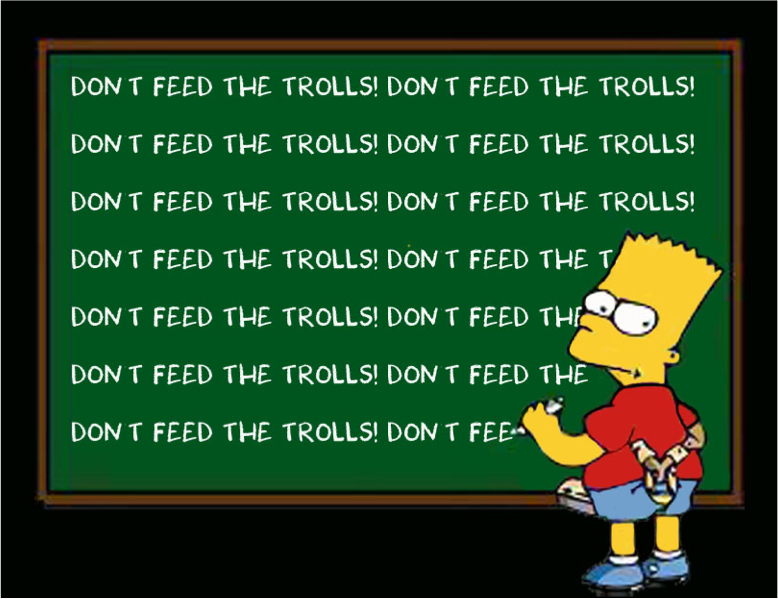
Don't Feed The Trolls
Disclaimer: All over the internet there are warnings about feeding the trolls. I am about to ignore them. Please bear with me.


When Katie Hopkins offered support to ‘controversial pick up artist’ Julien Blanc, according to the Huffington Post, the story surprised no one.
 Seeming to cultivate her status as a professional troll, she responded to the polls calling for Blanc to be denied a visa with a roll of her metaphorical eyes and once again managed to command the attention of every media outlet poised for her next inflammatory comment.

Blanc, a Swiss-American who claims to be able to ‘game’ women so ‘hard’ that they ‘beg’ for his attention, has been called the ‘Most Hated Man In The World’ after a video of him choking a woman in Tokyo went viral and Australia gave him the boot. And despite an apology interview with CNN’s Chris Cuomo, shaking the reputation of a racist and sexually violent misogynist is likely to take sometime.
 Did Katie Hopkins help him at all? Probably not. If anything, it surely emphasises his unenviable position. Why shouldn’t the Most Hated Man In The World have the support of Britain’s Most Hated Woman?
 But why don’t we look again at that tweet.
Accompanied by a photo of Blanc holding up a t-shirt, which has spawned almost as many headlines and hashtags as he has, Hopkins’ actual message seems to be: why is the UK afraid of a man who looks a lot like your average bloke about to go on a boozy holiday… and a lot less like the usual suspects who receive notice to ‘keep out of our country’.
 And I don’t like to admit it, but there’s the distinct possibility Hopkins might have an actual, valid, and (dare I say it) meaningful point.
 The vast power of social media is such that within days hundreds of thousands of people were signing up to keep Blanc’s ‘dating advice’ out of our country. There are two intriguing elements to this. The first is about the basic principles of free speech. The names on the sixteen-strong list of ‘banned persons’ from the Home Office belong to those ‘considered to be engaging in unacceptable behaviour by seeking to provoke, foment, glorify or justify terrorism’.
Thinking about what Hopkins posted, Julien Blanc doesn’t really fit into this category. Could the real question come down to freedom of speech? Can you really ban someone like Blanc on the basis of what he thinks?
What he reportedly offers is insight into making men sexually attractive. What the media revealed was a young chauvinist teaching seminars in demeaning and assaulting women. Indubitably unpleasant, his seminars are, unquestionably, ‘offensive… inappropriate’ and ‘emotionally scarring’. But no crime has been officially committed here. As Andy J. Semotiak said in his Forbes article, ‘simply holding obnoxious views is insufficient to deny entry’.
 Then the second point is this: would we have even have heard of Julien Blanc, would his name be as well known and his tactics as well publicised in the UK, if not for the heavy ‘no-platforming’ on the part of petitions desperate to keep him out?
 A ‘no platform’, encapsulates the idea that certain viewpoints have zero right to be expressed in public debate, and was described in The New Statesman. Powered by the vast power of social media, this ‘no platform’ for Julien Blanc worked so that within days hundreds of thousands of people were signing up to keep his ‘seduction advice’ out of our country.
 Does the success of the ‘no platform’ for Julien Blanc represent the power of the public voice? Does it suggest that we are stifling debate?
 It doesn’t really make much difference.
 Petitioning to keep him out gave him more attention and created a public profile through digital media that some people would pay for. The Guardian’s Marina Hyde certainly seems to agree, claiming that ‘bans turn ranting clerics you’ve never heard of into ones you never stop hearing about’.
 By lobbying against him, by creating a ‘no platform’, we essentially gave a little man with an even littler reputation a massive foothold in the all important column inches of the media. We fed the troll. We created the troll.
Now it doesn’t matter if he can come into the UK or not. Because now when he wants to go around spewing advice or his deliberately provocative life skills, people are going to listen through any and every medium he employs. They might not agree. They might not think what he says has any merit. But they will listen.
 This is precisely what we saw with Katie Hopkins, former Apprentice contestant and now professional ‘rent-a-gob’, Sun columnist, broadcaster and business woman. She made a name as someone with a sharp, often cruel tongue, usually appealing to some trending ‘whatever-ism’ of the day.
We gave her this platform though; we let her continue to post her many rancorous messages without censorship. Unlike Julien Blanc, for whom censorship has left him with the sole option of beaming in via Skype to talk to his British fans, Hopkins has been made to apologise a handful of times for offending people but almost always escapes further ridicule when she shrugs and tells the offendees it’s their fault for being offended.
She thrives because she trolls. And we let her.
She accepts and laughs at the outrage that she causes. And there’s always a small group somewhere accepting and laughing along with her.
Of course, there’s the slight question of whether Katie Hopkins is a traditional troll. She isn’t playing the ultimate devil’s advocate but equally she isn’t spouting opinions just to make Internet users so angry that their bloodied fingers expire trying to type an equally vitriolic defense. She seems to actually mean what she says, rather than saying it for the sake of irking 90% of the population.
Some love her for it and it maybe there’s an argument for saying her voice actually makes some issues come into the public eye that would otherwise be hidden from view. But the media definitely feeds her and if anyone tried to take her offline, I’m sure there would be outcry at those attempting to silence her voice.
My thought is that the media, particularly online and social media, complains about trolling and the spread of cyberbullying, but then it endorses or employs the same tactics when it suits the in vogue agenda.
Katie Hopkins has not empowered Katie Hopkins. Julien Blanc has not empowered Julien Blanc. The voice of shared media has.
Regardless of whether you think that Blanc should never hold a visa to the UK, or if you find Hopkins funny, multi-channel media has the power to make sure that Ice Buckets succeed, Comet-Landings disappear behind Kim Kardashian’s ginormous derrière, chauvinists become (un)popular icons, and trolls can stay beneath the crooked bridge, ready to gobble up any stray Billy-goats.
So I think this begs the question, and really the whole of this blog: should we feed the trolls?

Je serai poète et toi poésie,
 SCRIBBLER

ps. For more comments and information - why not go to the PHA Media website where I first published this post!

Monday, 25 August 2014

The ALS Ice Bucket Challenge

The ALS Ice Bucket Challenge


Critics are throwing cold water over the ALS Ice Bucket Challenge, but there’s something to be learnt from the viral video campaign that’s made more than a splash using social media.

Just when I thought I might have got away with it, when the whole craze looked ready to combust, it finally happened. I was nominated to do the Ice Bucket Challenge.  Meaning: you can now expect me to dump icy cold water over my head, film it, and post it up on my social media with an nifty hashtag #icebucketchallenge or #MND for your viewing pleasure.  

More importantly, it will hopefully add to the chain and bring that little bit more attention to ALS (amyotrophic lateral sclerosis), also known as Motor Neuron Disease in the UK. As a progressive neurodegenerative disease, ALS/MND leaves many sufferers completely paralysed, incapable of feeding themselves and eventually unable to breath on their own. It is a truly devastating condition and whilst it affects relatively few people, only half of those diagnosed survive the first three years and only 10% the first ten. Dumping ice water on our heads is meant to remind us of the paralysing effects of the disease as the cold instigates a similar albeit much, much smaller and short-lived physiological response.

Anyone paying attention will have followed the challenge’s tidal sweep. Gaining momentum after personalities from US show, Morning Drive, took part live-on air, the campaign quickly earned massive celebrity shout-outs from Jimmy Fallon, Will Smith, Victoria Beckham and Benedict Cumberbatch (dowsed five times in his video).


After that it rolled over to everyone else, hopping the Atlantic with a conspiratorial wink, encouraging social media uses worldwide to take part, donate and nominate.  It’s definitely made more than a splash. It’s swept across the globe in a tsnami of chilly, damp munificence.

Since becoming a social media phenomenon around three weeks ago the ALS Association has raised nearly £50 million (circa USD$80 million), roughly 500% more than it raised in the same period last year. It’s become so popular Macmillan Cancer Care and other charities have attempted to appropriate the campaign for themselves, to varying degrees of success.  As Dan Diamond wrote in Forbes, ‘the #ALSIceBucketChallenge—is everywhere. It’s annoying. But it’s working.’

However, as Diamond notes, many are growing tired of seeing the same videos over and over, those taking part have been accused of flagrant self-promotion rather than charitableness (aka: Slacktivism), and recently there’s been a sense of internet one-upmanship that has not always ended well.  It’s no longer enough to simply toss water over your head and shudder at the cold, now it’s necessary to endure several bucket loads, maybe even a forklift full – or an aeroplane – in order to gain the respect of your online buddies. The challenge itself should not be dangerous, and the number of funny, incredibly honest ‘fail’ videos could probably generate an entire episode of You’ve Been Framed but some people really have taken it too far. Reckless behaviour has allegedly been linked to the hospitalisation of one man and the death of a teenager in Inverkeithin, Fife. Part of the issue seems to be the peer-pressurised element of the Ice Bucket Challenge. Once you have been nominated, not performing can lead to criticism and even online abuse from ‘friends’ and followers.

Moreover, one of the risks is that the longer the campaign thrives, the more likely it seems to generate negative attention. The Guardian commented on this by suggesting that the social media that birthed the craze could also kill it. After all, there’s #droughtshaming to remind you that in places like Henan, China and California ‘taps have dried up, lakes and reservoirs are emptying and water wastage is being fined’. Plus some celebrities are refusing the challenge on ethical grounds. Pamela Anderson’s decision to forego the challenge because of reported medical testing on animals has already generated a following. The question of how much money is actually spent on salaries and publicity instead of research has similarly become a point of contention. 


But as we’ve already noted, the death knell could sound in the form of accidents and fatal injuries. Becoming associated with deaths and foolhardy egoism was the beginning of the end for Neknominate, which required participants to down alcohol and led to five UK deaths. As more become disillusioned with the plethora of soggy friends posting their videos the more likely it is for the negative press to take over the positivity and humour that has largely dominated thus far. Yet even Neknominate led to a more positive counter-campaign: ‘Donate-Nominate’, which asked participants to leave the beer and donate blood instead. It seems people want to use social media for good causes, even when posturing attempts to subvert it. Perhaps this is what we are seeing when people react against the participants who fail to mention the charity or cause.

Viral chains and popular organisations are not new. Ever since the Civil Rights Movement contemporary media (in particular television and radio) has been used to emphasise mass protests and popular causes. In 1986, Hands Across America instigated a benefit event in which 6.5 million people held hands in a human chain across the continental US. And in 1989, 2million people created a ‘Chain of Freedom’ across 600km to draw attention to the popular vision of Baltic independence from the USSR.  With so many involved, these human chains symbolised unity within a nation, gained international attention and like the Ice Bucket Challenge, emphasised the power of mass communication when the message was both emotionally captivating and visually stunning. The ALS Challenge may not be ‘emotional’ or ‘stunning’ per se, but it does tap into the desire to be part of a larger cause and there has certainly been some heart-wrenching content mixed in with the humorous and downright hilarious.


What is poignant, is that it has appropriated Twitter, Facebook, and YouTube to generate the perfect media storm. To make a disease and its charity personal as well as global. 

The ALS Ice Bucket Challenge has done everything right. Timed perfectly to coincide with summer sunshine, it took a niche plight, mixed in some celebrities (which led to more A-listers than probably ever anticipated), made it a personal challenge that everyone could interact and engage with and they kept it simple. They let it grow and take on a life of its own and here we are in the present, wondering where it might go next.

Whatever the verdict, be it a health risk or a meaningful act of charity, I will tipping a bucket over my head this evening.

Thank you for the nomination.


Je serai poète et toi poésie, 

SCRIBBLER